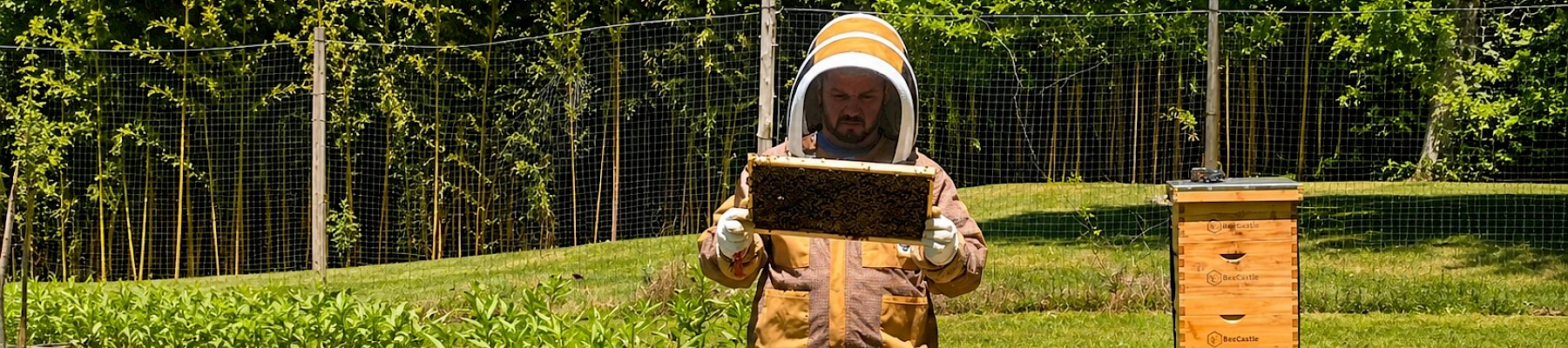
Discover how Windrose turns maple trees, honeybees, and seasonal harvests into authentic farm-to-table dining.
Walk the grounds at Windrose, a one-time farm folded into New York's Hudson Valley, and you pass maple trees, beehives, and garden beds that all report to the same manager: the calendar.
Windrose’s Chef Thomas Borowitz treats that calendar as a co-author rather than a constraint.
Asked to boil the whole philosophy down to a single word, the answer comes fast. "If I had to sum it all up into one, it would probably be authenticity."
Plenty of restaurants stitch that word onto a menu and hope nobody checks. At Windrose, it has to clock in for a shift.
Your Strawberry Has Seen More of the World Than You Have
Picture a strawberry in a northern grocery store in January.
It was grown a couple of thousand miles south, picked firm and pale so it could survive the journey, and trucked up to sit under fluorescent light looking redder than it tastes. Bite it, and you get crunch, a little water, and the faint rumor of fruit.
The winter tomato pulls the same con. Most are harvested green, then coaxed into blushing with a puff of ethylene gas in a warehouse. They show up uniform, durable, and about as flavorful as the box they ship in. We've bred and engineered produce for the trip instead of the plate, and somewhere in all that logistics we misplaced the reason people eat in the first place.
That gap is exactly what a real farm-to-table kitchen exists to close. "We want to be very authentic to farm-to-table cooking, using seasonal ingredients," the chef says. The load-bearing word there is seasonal. Not seasonal as marketing. Seasonal as a rule about what's even allowed on the plate this week.
Why the Menu Reads Like a Weather Report
A peach in its prime and a peach shipped from the off-season aren't the same fruit wearing different hats. Ripeness is when sugars and acids hit their balance and aromatic compounds peak, and a lot of that fades the moment something is picked early or stored for weeks. Spinach can shed a chunk of its vitamin C within days of harvest. Flavor and nutrition are both on the clock, and the clock starts at the stem.
The chef builds around that reality instead of fighting it. "We want to use ingredients in the peak of their season that are vibrant, that are ripe, so you get the most flavor out of them and the most nutrients." Which means the kitchen has to be fluent in timing. "You really need the knowledge of the seasons, what's in season when, and what's available when, and that all is what influences and inspires our menus." The menu, in other words, gets a rewrite every few weeks, and the weather holds the pen.
The Two-Week Window That Runs the Whole Operation
Nothing makes the point sharper than maple.
"The maple trees are only available at maybe two weeks out of the year," the chef notes, and that scarcity isn't a marketing flourish.
Sap runs on a freeze-thaw rhythm in late winter: nights below freezing, days above, pressure building and releasing inside the trunk. The moment buds break in spring, the sap turns bitter and the season slams shut on its own. It also takes roughly 40 gallons of sap to boil down to a single gallon of syrup, so that drizzle on the plate represents a genuinely tiny window doing a lot of work. Miss it, and you wait a full year. No expediting that order.
The bees enforce the same discipline from a different angle.
They tie the kitchen to bloom times, since a hive only makes honey when there's nectar to gather, which makes every jar a kind of liquid map of what flowered nearby that month. Roughly a third of what humans eat leans on pollinators to exist at all, so the hives aren't a garnish to the operation. "Having them pollinate our gardens is supporting our world and our future," the chef says. That ethic runs into the kitchen too, where scraps don't get to be scraps. "We really promote utilization."
Waste, here, is a failure of imagination more than a fact of cooking.
Explore Dining at Windrose on Hudson >>
The Bite You'll Taste Again in Thirty Years
For all the talk of trees and pollen, the chef's actual goal is stored somewhere softer. "I hope when our guests leave that they really get an experience and a memory, most of all." Not a full stomach. A memory. The ambition is for a guest to taste something years later and be pulled straight back: "Wow, this tasted just like it did at Windrose."
There's real wiring behind that hope. Smell and taste route through the olfactory bulb, which sits unusually close to the brain's memory and emotion centers, the hippocampus and amygdala. Flavor and feeling get filed in the same drawer, which is why one bite can resurrect an entire afternoon you thought you'd forgotten. Proust needed a whole novel and a soggy madeleine to chase that sensation. A genuinely seasonal dish does it faster, precisely because it's bound to a moment that can't be summoned on demand. You can't fake the memory if you can't fake the ingredient.
The Whole Point, in One Word
Authenticity turns out not to be a poster on the wall. It's the maple deadline, the bees clocking the bloom, the menu that won't sit still, and the meal a guest carries off the property and keeps. The land sets the terms, the season writes the menu, and if the kitchen does its job, the memory outlasts the meal by a few decades. Cooking by the calendar sounds like a limitation right up until you taste what it protects.
Plan Your Seat at the Table
The maple window won't wait, and neither will the rest of the calendar.
Whatever's at its peak the week you visit is exactly what you'll taste, which is the whole point of showing up in person. See current menus, check seasonal availability, and book your group's experience at windroseonhudson.com.
Come hungry, leave with the memory.